
Side Dishes
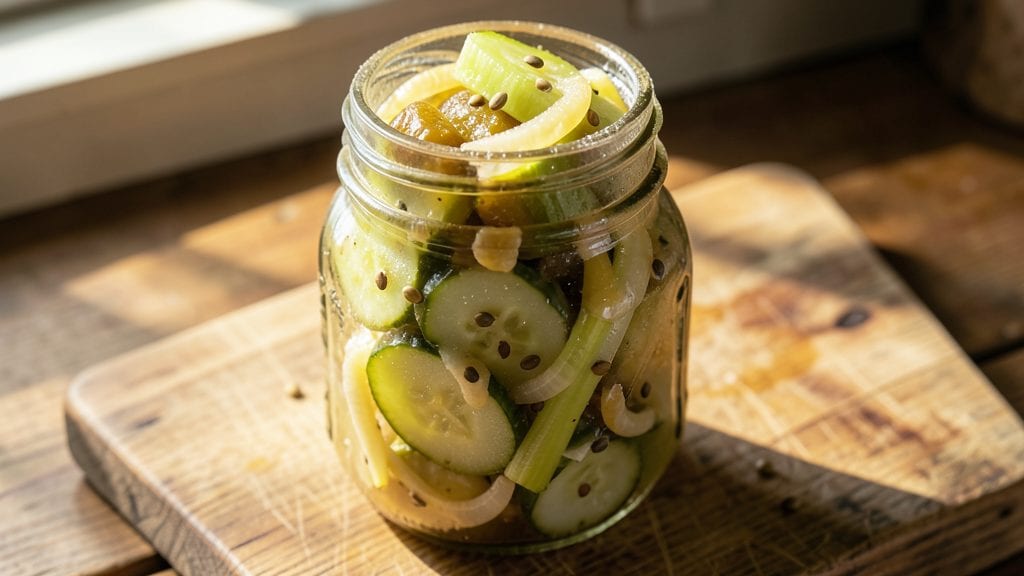
This Amish bread and butter pickles recipe delivers that perfect balance of sweet, tangy, and crunchy flavors that elevates any sandwich or charcuterie board.
The traditional method relies on natural fermentation and precise spicing—no artificial preservatives here—just the kind of homestyle taste that makes every bite feel like a family gathering. I’ve perfected this recipe over years of canning, ensuring the right texture and flavor every time while keeping the process safe and straightforward.
The secret lies in the vinegar-to-sugar ratio and a 15-minute simmer that infuses the cucumbers with just the right amount of sweetness and tang. Mustard seeds and celery seeds add that signature Amish warmth, while dill and turmeric contribute depth and color.
This isn’t just a side dish—it’s a versatile condiment that transforms simple meals into something special, whether paired with ham, cheese, or even a classic Reuben sandwich.
With water bath canning, you’ll preserve these pickles for months, ready to pull from your pantry whenever you need that bright, crunchy burst of flavor.
The process is foolproof if you follow the 10-minute processing time and proper jar sealing, and I’ll walk you through every step—including safety precautions—to ensure your pickles stay fresh and delicious. Once you taste the difference between store-bought and homemade, you’ll never go back.
Perfect for holiday gifts, meal prep, or serving alongside charcuterie, these pickles are a labor of love that pays off in every tangy, crunchy bite. Let’s get started on a batch that’ll have your kitchen smelling like summer all year round.
Ingredients for amish bread and butter pickles
Sweet, tangy, and crunchy—these 13 ingredients transform simple veggies into homestyle pickles that elevate any meal.
| Ingredient | Amount | Notes |
|---|---|---|
| Fresh Kirby Cucumbers 🥒 | 4 lb | Thinly sliced, uniform size |
| White Vinegar 💧 | 2 cups | Distilled, 5% acidity preferred |
| Granulated White Sugar 🍚 | 2 cups | Light brown sugar for depth |
| Yellow Onion 🧅 | 1 whole | Thinly sliced, sweet variety |
| Celery Stalks 🥬 | 2 whole | Thinly sliced, leafy tops trimmed |
| Mustard Seeds 🌶️ | 1 ½ tbsp | Whole, for signature Amish flavor |
| Celery Seeds 🌿 | 1 tbsp | Ground for aromatic depth |
| Ground Turmeric 🌼 | 1 tsp | For vibrant color and earthiness |
| Dried Dill Weed 🌿 | 1 tbsp | Or 1 tbsp fresh dill finely chopped |
| Salt 🧂 | 1 ½ tbsp | Diamond Crystal kosher preferred |
| Black Peppercorns 🌶️ | ½ tsp | Cracked for subtle heat |
| Water 💧 | 2 cups | Filtered or distilled preferred |
| Pickling Spice Blend 🌶️ | 1 tbsp | Optional, for extra warmth |
The cucumbers are non-negotiable—Kirby cucumbers (the bumpy, short ones) hold their crunch best, but any firm, young cucumber works in a pinch. Local farmers markets often carry them in summer, but most grocery stores stock them year-round. Look for cucumbers that are bright green and firm to the touch—avoid any with soft spots or yellowing. The onion and celery should be fresh and crisp, not wilted or rubbery. For the spices, Penzeys Spices or bulk bins at natural food stores carry the highest quality mustard and celery seeds—these are the backbone of that classic Amish flavor. If you can't find whole mustard seeds, ground mustard at half the amount works, but the crunch from whole seeds is worth seeking out.
No white vinegar? Apple cider vinegar works beautifully—just add an extra 1/2 teaspoon of sugar to balance the flavor. Running short on sugar? Honey or maple syrup can substitute at a 3:4 ratio (use 1.5 cups for every 2 cups sugar), though the texture will be slightly different. The turmeric is key for that signature golden hue—skip it only if you're sensitive to strong flavors. For dill, fresh is ideal, but dried works at one-third the amount. If you're feeling adventurous, swap the pickling spice blend for 1/2 teaspoon each of ground coriander and allspice for a different but equally delicious twist. And here's a pro tip: toast your mustard and celery seeds in a dry pan for 30 seconds before adding to the brine—this deepens their flavor dramatically (worth the extra minute!).
These pickles keep beautifully—fridge for 3 weeks or canned for 1 year using water bath canning. For canning, use pint-sized jars with 1-inch headspace, and process for 10 minutes in boiling water. The jars should seal themselves—if any don't, refrigerate those for immediate use. Once opened, store in the fridge and consume within 2 weeks. I always make a double batch—one for the pantry and one for gifting. The flavor actually improves after a few weeks as the spices infuse deeper. For meal prep, portion into small jars or containers so you can grab just what you need for sandwiches or charcuterie boards.
Why You'll Love This Recipe
- No-Chop Nightmare: I swear by this recipe because you can literally slice those Kirby cucumbers with a knife and call it a day—no mandoline, no fuss. The onions and celery get a quick rough chop, but honestly? No one’s judging. (Yes, even on a Tuesday night.)
- Sweet-Tart Magic: That perfect balance of sugar and vinegar? It’s like a hug for your taste buds. The celery adds this subtle earthiness, while the onions bring warmth—every bite is crisp, tangy, and just sweet enough to make you want to eat them straight from the jar.
- Jars for Days: Between us, this recipe makes so many jars you’ll be gifting them to neighbors. I’ve got a batch in my pantry right now that’s been there for three months, and they’re still perfect for sandwiches, burgers, or just snacking.
- Pantry Staple: You already have the ingredients—vinegar, sugar, onions—so it’s not just cheap, it’s smart. Make a big batch, store it, and forget about buying overpriced pickles at the store. My kids think they’re a treat, but I know they’re just saving me money.
Step-by-step instructions for Amish bread and butter pickles
Here's how to create those iconic sweet-spiced pickles with perfect texture and balanced flavor.
Prepare and Sterilize Your Equipment
Start by washing all your jars, lids, and utensils in hot, soapy water and then sterilize them by boiling for 10 minutes. I use a large pot for this—just place the jars and lids in a canning rack or upside down in the pot. Sterilization prevents spoilage and ensures your pickles stay fresh for months.
While the equipment sterilizes, prepare your cucumbers by cutting off the ends and slicing them into ¼-inch thick rounds. For uniform slices, I like to use a mandoline slicer—it gives you consistent thickness which is key for even pickling. Place the sliced cucumbers in a large bowl and set aside.
Create the Sweet-Spiced Brine
In a large saucepan, combine the 2 cups white vinegar, 2 cups granulated white sugar, 2 cups water, 1.5 tablespoons salt, 1 tablespoon dried dill weed, 1 tablespoon celery seeds, 1.5 tablespoons mustard seeds, 1 teaspoon ground turmeric, 0.5 teaspoon cracked black peppercorns, and 1 tablespoon pickling spice blend. Stir well until the sugar and salt are completely dissolved.
Bring the mixture to a boil over medium-high heat, then reduce the heat to medium-low and let it simmer for 10 minutes. This allows the flavors to meld together and creates that signature Amish bread and butter taste. You'll notice the liquid will become slightly syrupy as it reduces—this is perfect for coating each cucumber slice.
Layer Cucumbers and Aromatics
In each sterilized jar, layer the sliced cucumbers, thinly sliced yellow onion, and thinly sliced celery stalks. I like to pack them tightly but not too forcefully—you want room for the brine to circulate and penetrate the vegetables. For an 8-quart batch, you'll need about 2 cups of cucumbers, ½ cup onion, and ½ cup celery per quart jar.
Leave about ½ inch of headspace at the top of each jar—this prevents the jars from sealing properly if filled too full. The headspace also allows for the natural expansion of the vegetables as they absorb the brine.
Fill Jars and Process for Preservation
Ladle the hot brine over the layered vegetables until each jar is filled to within ½ inch of the rim. Use a non-metallic utensil to tap the jars gently on the counter—this helps remove any air bubbles trapped between the slices. The liquid should cover all the vegetables completely.
Wipe the rims of the jars with a clean, damp cloth to ensure a proper seal, then place the lids on and screw on the bands until fingertip tight. Process the jars in a boiling water bath for 10 minutes—this sterilizes the jars and creates a vacuum seal. For best results, use a canning rack in your stockpot to keep the jars off the bottom.
Cool, Store, and Enjoy
Remove the jars from the water bath and let them cool undisturbed for 12-24 hours. You'll hear the satisfying "ping" as the lids seal. Check each lid to ensure it's concave—this indicates a proper seal. If any jars don't seal, refrigerate those immediately and use within 1 week.
Store the sealed jars in a cool, dark place for up to 1 year. The flavors will continue to develop and mellow over time, making these pickles perfect for sandwiches, burgers, or just enjoying straight from the jar. Each bite should deliver that perfect balance of sweet, tangy, and spiced flavors with a satisfying crunch.
Pro Tips For Making Amish Bread And Butter Pickles
- Trim Celery Right: DESCRIPTION:
- Boil Vinegar First: DESCRIPTION:
- Salt Cucumbers 30 Minutes: DESCRIPTION:
- Pack Jars Tight, Then Shake: DESCRIPTION:
Wine and beer pairings for this recipe
Sweet & Tangy Wines
Amish bread and butter pickles pair beautifully with off-dry Riesling from Germany or Washington State—its honeyed notes and crisp acidity mirror the sweet-spiced profile of the pickles. I love Dr. Loosen Blue Slate Riesling from the Mosel region, where the slight mineral edge cuts through the sugar.
For a budget-friendly option, try Chateau Ste. Michelle Riesling with its bright citrus finish. 🍷
Crisp Beer Pairings
A Belgian witbier like Hoegaarden or Stella Artois adds effervescence that cleanses your palate between tangy bites. The coriander and orange peel notes in these beers complement the mustard seeds in the pickles beautifully. For a local favorite, Allagash White (with its creamy texture) works wonderfully too. 🍺
Unexpected Cocktail Twist
Turn your pickles into a cocktail garnish by muddling 2-3 slices with 1 oz fresh lemon juice and ½ oz honey> in a shaker. Add ice, shake with 2 oz bourbon>, and strain into a glass over a large cube.
Garnish with a pickle spear—this Bourbon Pickle Smash is a Southern-inspired crowd-pleaser. 🍹
Cider & Mead Options
For a non-alcoholic pairing, dry hard cider like Angry Orchard or Woodchuck balances the sweetness with its tart apple notes. If you prefer fermented drinks, a dry mead with subtle spice undertones (like Cornucopia Dry Mead) enhances the mustard and celery seed flavors without overpowering them. 🍏
Regional Pairing Tips
In the Midwest, where Amish pickles originated, a local craft lager (like New Glarus Spotted Cow) pairs perfectly with the hearty flavors. For Southern-style sandwiches, a sweet tea (brewed with 2 tbsp honey>) mirrors the sweet-tangy balance of the pickles.
In New England, a dry sparkling wine like Gruet Brut adds a festive touch to charcuterie boards. 🗺️
Cheese & Charcuterie
These pickles shine on boards with sharp cheddar (like Cabot Clothbound Cheddar) or smoked gouda—the saltiness of the cheese contrasts the sweetness perfectly. Pair with prosciutto di Parma or salami for a classic Italian-inspired spread.
For a vegetarian option, add aged cheddar, walnuts, and honeycomb for a sweet-savory balance. 🧀
Nutrition facts
Frequently asked questions
Why do Amish bread and butter pickles have such a distinct flavor?
The signature taste comes from the perfect balance of mustard seeds (for crunch and warmth), celery seeds (earthy depth), and turmeric (golden color and subtle bitterness). The 15-minute simmer of vinegar, sugar, and spices creates a syrupy brine that perfectly coats each slice, while the 1:1 vinegar-to-sugar ratio ensures that sweet-tangy harmony.
Can I make these pickles without canning? How long will they last?
Skip the canning process and store the pickles in an airtight container in the fridge. They'll stay fresh for 3-4 weeks—just ensure the brine completely covers the vegetables. For longer storage, freeze them in portions for up to 6 months, though texture may soften slightly.
What’s the best way to slice cucumbers for even pickling?
Use a mandoline slicer for ¼-inch thick slices—this ensures uniform cooking and crunch. If you don’t have one, a sharp knife works, but measure each slice against a ruler to maintain consistency. Avoid thick or thin slices, as they won’t pickle evenly.
My pickles turned out too sweet—how can I fix it next time?
Adjust the vinegar-to-sugar ratio to 1.5:1 vinegar to sugar (e.g., 2.5 cups vinegar to 1.5 cups sugar) for more tang. You can also add ½ teaspoon extra mustard seeds to balance sweetness with heat. Taste the brine before filling jars—it should be pleasantly sharp, not cloying.
Are these pickles safe to eat during pregnancy?
Homemade pickles are generally safe if made with proper canning techniques (like the 10-minute water bath here). However, pregnant women should avoid raw onions or celery (common in recipes) due to listeria risk. For extra safety, sterilize all veggies by blanching them in boiling water for 2 minutes before pickling. Always consult your healthcare provider.